
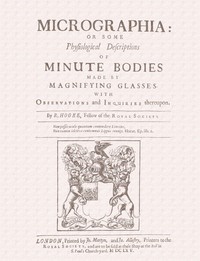
Micrographia by Robert Hooke
Okay, let's set the scene: London, 1665. The Royal Society is buzzing with new ideas, and a curious fellow named Robert Hooke gets his hands on one of the best microscopes around. Instead of just looking at prepared slides, he turns it on everything. Micrographia is the stunning result: a big, beautiful book of his observations.
The Story
There's no traditional plot here. The 'story' is the journey of discovery. Hooke methodically examines items from his daily life—a needle's point, fine silk, a bee's stinger, frost on a window. He draws what he sees with incredible detail. When he looks at a flea, he doesn't see just a pest; he reveals a monstrous, armored creature of 'curious adornment.' A piece of cork becomes a honeycomb of tiny rooms, which he calls 'cells.' Mold isn't just fuzz; it's a delicate forest of stalks and spheres. Each observation is a short chapter where he describes the object, draws it, and then wonders aloud about what it means. The book builds a new vision of the world, piece by tiny piece.
Why You Should Read It
You should read this to feel the raw thrill of discovery. Hooke's voice is wonderfully direct. He's amazed, confused, and sometimes grossed out by what he finds. You can feel him thinking on the page. It’s not dry data; it's a guy saying, 'Whoa, look at THIS!' The themes are huge: seeing the extraordinary in the ordinary, the importance of looking closely, and how technology can completely reshape our understanding. The characters are Hooke and the hidden creatures he unveils. You end up rooting for him as he puzzles over the structure of a feather or the eye of a fly.
Final Verdict
Perfect for anyone with a curious mind, especially fans of science history, natural wonders, or beautiful old books. It's not a quick read—the 17th-century prose takes some getting used to—but it's worth the effort. Think of it as an adventure book, but the uncharted territory is your own backyard, seen through a magical lens. If you like the idea of a time capsule that contains the moment humanity first truly saw the microscopic world, this is your book.
This text is dedicated to the public domain. You can copy, modify, and distribute it freely.
Oliver Clark
1 year agoI didn't expect much, but it manages to explain difficult concepts in plain English. I will read more from this author.
Amanda Johnson
3 months agoFrom the very first page, the flow of the text seems very fluid. Exactly what I needed.
Thomas Hill
4 months agoSolid story.
Matthew Lopez
1 year agoI had low expectations initially, however the depth of research presented here is truly commendable. Truly inspiring.

Mark White
6 months agoLoved it.