
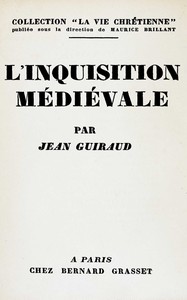
L'Inquisition médiévale by Jean Guiraud
Let's get one thing straight: this isn't a beach read. Jean Guiraud's L'Inquisition médiévale is a serious, detailed history book first published in 1928. Guiraud wasn't trying to write a thriller; he was trying to explain a complex and terrifying institution from the ground up, using the actual records left behind.
The Story
There isn't a traditional plot with heroes and villains. Instead, Guiraud builds the Inquisition piece by piece, like an investigator reconstructing a crime scene. He starts with the 'why': the rise of religious movements that challenged the Catholic Church in the 12th and 13th centuries. The Church and secular rulers felt their power and the soul of society were under attack. The Inquisition was their organized response—a permanent legal office designed to find, question, and judge heretics. Guiraud walks you through the entire process: how inquisitors were trained, how they conducted investigations, the rules of evidence (which were shockingly modern in some ways and horrifying in others), the use of imprisonment and torture, and the final sentences. It's a cold, procedural look at a system of control.
Why You Should Read It
What hit me hardest was the chilling normality of it all. Guiraud presents the Inquisition not as a cartoon of evil, but as a bureaucracy. The inquisitors were often intelligent, pious men who believed they were saving souls and protecting the community. That's far more unsettling than any mustache-twirling villain. The book forces you to ask uncomfortable questions: How do good people justify terrible systems? How does fear of an idea lead to the creation of a machine like this? Guiraud's own perspective as a conservative Catholic historian adds another layer—he condemns the excesses but understands the fear that sparked it. You're not just learning facts; you're wrestling with a difficult legacy of faith, power, and human failing.
Final Verdict
This book is perfect for history buffs and anyone interested in the messy intersection of religion, law, and state power. It's for readers who don't want a sensationalized story but a patient, document-driven explanation. Be warned: it's dense, it's academic in tone, and it was written a century ago, so some historical interpretations have evolved. But as a primary source itself—a deep dive from a scholar of Guiraud's era—it's fascinating. You won't get a fast-paced narrative, but you will get a profound understanding of one of history's most infamous institutions. Keep a modern history podcast or article handy for context, and prepare to have your assumptions challenged.
This is a copyright-free edition. It is now common property for all to enjoy.
Kenneth Rodriguez
1 year agoSurprisingly enough, the plot twists are genuinely surprising. This story will stay with me.






Linda Lopez
1 year agoThis book was worth my time since the author's voice is distinct and makes complex topics easy to digest. Exactly what I needed.