
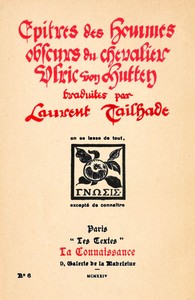
Epitres des hommes obscurs du chevalier Ulric von Hutten traduites par Laurent…
Okay, let's set the scene. It's the early 1500s in Germany. A huge intellectual fight is brewing between the old-school, traditional church scholars and the new humanist thinkers who love classical learning and want to reform things. Enter Ulrich von Hutten, a fiery knight who's also a brilliant writer and a major supporter of Martin Luther.
The Story
This book isn't a novel with a plot. It's a collection of made-up letters. Hutten presents them as if they were real correspondence between conservative monks who are absolutely panicking about the rise of humanism. The "story" is in their ridiculous complaints. They write to each other whining about how learning Greek is heretical, how their fellow monks are stealing the good wine, and how these newfangled thinkers like Erasmus and Reuchlin are destroying everything. The humor is savage. Hutten doesn't just tell us these guys are backwards; he lets their own (invented) words hang them. Each letter builds a picture of a group more concerned with their stomachs and their privileges than with truth or faith.
Why You Should Read It
First, it's genuinely funny. The monks come off as buffoons, and the satire is sharp enough to still land today. But more than that, it shows how powerful mockery can be in a serious debate. Hutten didn't write a dry theological treatise. He created a viral meme of his time, a piece of propaganda so effective it made his opponents a laughingstock. Reading it, you get a front-row seat to the culture wars of the Renaissance. You see how ideas spread and how character assassination worked before social media. It’s a reminder that changing people's minds often requires making them laugh at the old way of thinking.
Final Verdict
This is a niche book, but a fascinating one. It's perfect for history buffs who want to go beyond kings and battles and see the messy, personal side of the Reformation. It's also great for anyone interested in satire, political humor, or the long history of people using wit as a weapon. If you enjoy shows or books that expose hypocrisy through comedy, you'll find a kindred spirit in Ulrich von Hutten. Just be ready for some very specific 16th-century inside jokes—the footnotes are your friend!
This content is free to share and distribute. Thank you for supporting open literature.
Mary Ramirez
1 year agoBased on the summary, I decided to read it and the storytelling feels authentic and emotionally grounded. I couldn't put it down.
Anthony Martinez
1 month agoAfter hearing about this author multiple times, it creates a vivid world that you simply do not want to leave. Exceeded all my expectations.
Patricia Clark
5 months agoI stumbled upon this title and the narrative structure is incredibly compelling. Highly recommended.
Carol Wright
1 year agoI stumbled upon this title and the arguments are well-supported by credible references. I would gladly recommend this title.





Donna Smith
4 months agoAmazing book.