
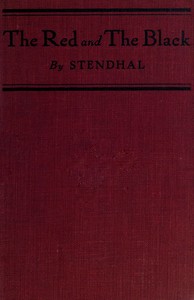
The Red and the Black: A Chronicle of 1830 by Stendhal
Stendhal's The Red and the Black is often called one of the first modern novels, and reading it, you can see why. Forget stuffy prose—this book moves with the energy of a psychological thriller. It follows Julien Sorel, a young man torn between two paths in post-Napoleonic France: the 'red' of military glory (now closed to him) and the 'black' of the church (his only way up).
The Story
Julien is brilliant, sensitive, and painfully aware he's born into the wrong class. Using his photographic memory of the Latin Bible as a ticket, he leaves his father's sawmill to become a tutor in the provincial town of Verrières. There, he begins a dangerous affair with Madame de Rênal, the mayor's wife. After that scandal forces him out, he enters a seminary and later moves to Paris as secretary to the powerful Marquis de la Mole. In Paris, he faces his greatest challenge: winning the heart (and hand) of the Marquis's proud daughter, Mathilde, while navigating a world built on lies and appearances. His entire journey is a high-wire act of calculated performance and genuine passion, and you're constantly waiting for the moment his two worlds collide.
Why You Should Read It
What grabbed me was Julien himself. He's not a hero. He's arrogant, often cruel, and a master manipulator. But Stendhal lets us inside his head, and you understand every jealous thought, every moment of crippling insecurity, every desperate calculation. You root for him even as you cringe at his choices. The book is a razor-sharp look at how society forces people to wear masks. Julien isn't the only hypocrite; he's just the most talented one in a world full of them. The love stories here are messy, intense, and feel real—they're battles of wills as much as affairs of the heart.
Final Verdict
This is perfect for readers who love complex, flawed characters and stories about social climbing. If you enjoyed the scheming of Succession or the psychological depth of Dostoevsky, you'll find a fascinating ancestor here. It’s a historical novel that doesn't feel dusty because its central question is timeless: How much of yourself are you willing to sacrifice to get ahead? Fair warning: Julien's inner monologue can be intense, and the politics of 1830 France are part of the fabric. But if you're ready for a smart, passionate, and utterly gripping character study, this classic absolutely earns its reputation.
This historical work is free of copyright protections. Thank you for supporting open literature.
Sandra Young
3 months agoHonestly, the character development leaves a lasting impact. This story will stay with me.
Donald Allen
1 year agoGreat reference material for my coursework.
Steven Wright
11 months agoGreat digital experience compared to other versions.
Joseph Taylor
1 year agoThanks for the recommendation.





Lisa Smith
5 months agoGreat digital experience compared to other versions.