
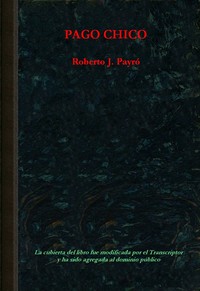
Pago Chico by Roberto Jorge Payró
First published in 1908, Roberto J. Payró's Pago Chico is a classic of Argentine literature that holds up a brilliantly funny mirror to small-town life. It’s not a single, linear plot, but a series of connected episodes that paint a full picture of a place called Pago Chico.
The Story
The story kicks off when a national engineer arrives to oversee the building of a much-needed bridge. You'd think this would be straightforward, right? Wrong. This simple act of infrastructure becomes the town's biggest social event and political football. Suddenly, everyone has an opinion. Local bigwigs see it as a chance to gain influence. Shopkeepers dream of new business. Gossips have a fresh topic to chew on for weeks. We follow a rotating cast of characters—the pompous mayor, the scheming journalist, the idealistic young man—as they navigate this new 'crisis.' Their attempts to profit from the project, or simply to look important while doing nothing, drive the story forward in a series of clever, often satirical scenes.
Why You Should Read It
What makes this book so special is how familiar it feels, even over a century later. Payró has a fantastic eye for the tiny details of social life. The way people posture, the empty promises, the jealousy over trivial honors—it’s all here, and it’s painfully funny because we still see it today. The characters aren't evil; they're just human, wrapped up in their own small worlds. Reading it, you don't just laugh at them; you recognize a bit of that same vanity in yourself and the people around you. It’s a gentle, insightful roast of how societies work.
Final Verdict
This book is perfect for anyone who loves character-driven stories or social satire. If you're a fan of authors who observe human folly with a warm but critical eye—think a Argentine twist on Jane Austen's village dramas or even the quiet humor of someone like George Eliot—you'll find a lot to love here. It’s also a great, accessible entry point into classic Latin American literature. You don't need to be a history expert; you just need to have ever lived in or observed a small community where everyone is trying to be a big fish in a very small pond.
This book is widely considered to be in the public domain. Share knowledge freely with the world.
Liam Scott
1 year agoI stumbled upon this title and it challenges the reader's perspective in an intellectual way. Worth every second.
Donna Gonzalez
1 year agoFrom the very first page, the content flows smoothly from one chapter to the next. Don't hesitate to start reading.
George Anderson
5 months agoJust what I was looking for.
Joshua Davis
9 months agoWithout a doubt, it challenges the reader's perspective in an intellectual way. Exceeded all my expectations.


Mary White
5 months agoBased on the summary, I decided to read it and the author's voice is distinct and makes complex topics easy to digest. I learned so much from this.