
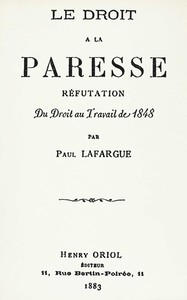
Le droit à la paresse : réfutation du droit au travail de 1848 by Paul Lafargue
Published in 1883, Paul Lafargue's The Right to Be Lazy isn't a story with characters and a plot. Think of it as a passionate, provocative essay that picks a fight with an entire idea. That idea is the 'right to work,' a slogan championed by socialists and reformers of his time. Lafargue, a doctor and Karl Marx's son-in-law, turns this notion completely on its head.
The Story
There's no traditional narrative here. Instead, Lafargue builds a case. He looks at the Industrial Revolution and sees not progress, but a society drunk on work. Workers, he argues, have been conned. They fight for the 'right' to toil endlessly for low wages, which only enriches factory owners and makes everyone exhausted. He points to ancient cultures and even some animals to show that constant labor isn't natural. His solution? A radical reduction of the workday to just three hours, freeing up massive amounts of time for rest, pleasure, and intellectual pursuits. The 'plot' is the journey of his argument, from diagnosing work as a social disease to prescribing laziness as the cure.
Why You Should Read It
I picked this up expecting a dry, historical pamphlet. What I got was a book that made me laugh and then sit back and think. Lafargue's sarcasm is brilliant. He mocks the moralists of his day who preached about the dignity of labor while living lives of leisure. Reading it in the 21st century, during our own conversations about burnout, the four-day workweek, and 'quiet quitting,' is a trip. It feels less like a relic and more like a missed memo from history. It challenges the core belief that our value is tied to our productivity, which is a liberating (and slightly uncomfortable) thought to sit with.
Final Verdict
This is a perfect book for anyone feeling cynical about hustle culture, for fans of radical history who want to see a different side of socialist thought, or for readers who just enjoy a smart, sassy argument. It's short, under 100 pages, so it's not a huge commitment. Don't go in looking for a practical policy guide—it's more of a philosophical grenade. It's for the reader who wants to be provoked, who enjoys seeing sacred cows get tipped over, and who might just need an 1883 permission slip to go enjoy their afternoon a little bit more.
This masterpiece is free from copyright limitations. You can copy, modify, and distribute it freely.
Daniel Thompson
1 year agoMy professor recommended this, and I see why.
Nancy Thompson
1 year agoThis is one of those stories where the character development leaves a lasting impact. Worth every second.
Joshua Lewis
1 year agoHelped me clear up some confusion on the topic.





Nancy Taylor
1 year agoLoved it.